A built-in strainer still needs cleaning
An integrated filter saves a loose part but still traps leaves. Clean the outlet deliberately so yesterday's fragments do not interrupt today's pour.
Notice where the leaves stop
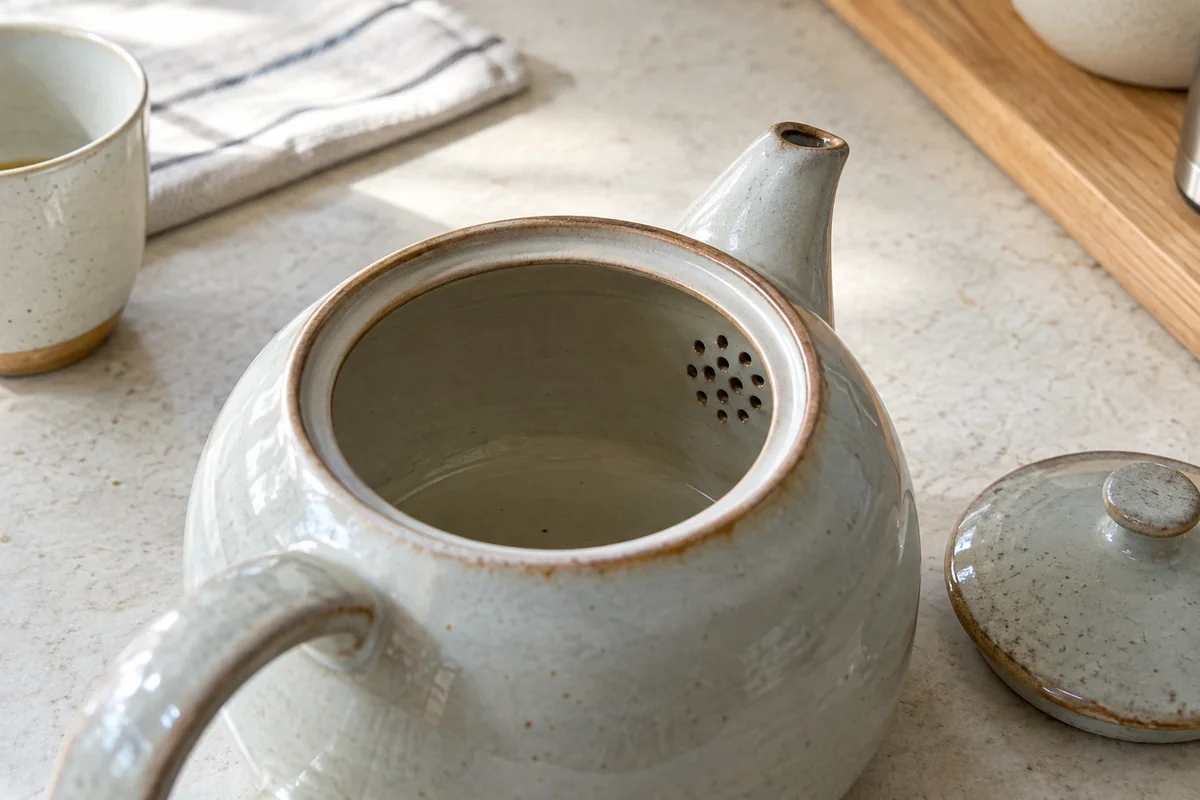
A built-in strainer may be a panel of small ceramic holes, a metal mesh fixed inside the pot or a shaped barrier near the spout. Its job is easy to overlook because there is no basket to lift out. After pouring, look at that area before discarding the main pile of leaves. Fine fragments can remain against the filter even when the rest of the cavity appears empty.
Remove loose leaves promptly once the pot can be handled safely. A gentle rinse before fragments dry in place is usually easier than dealing with a hardened layer later. Follow the manufacturer's cleaning instructions for the pot and the filter material. Do not assume that a metal mesh inside a clay vessel gives permission to use the same detergent or machine cycle as a separate stainless-steel basket.
Use the water path to your advantage
Where the maker permits it, rinse from a direction that helps dislodge particles rather than pressing them more firmly into the holes. Hold the pot securely over the sink and keep the flow controlled. A soft, appropriately sized cleaning tool may help with accessible areas, but avoid forcing sharp objects through a fine mesh or ceramic opening. A damaged filter can be more troublesome than the original leaf fragment.
Check the result with clean water. A slow or uneven flow may mean that an obstruction remains, though the spout's design also affects pouring. Compare with how your own pot normally behaves rather than expecting every vessel to empty at the same speed. If a fixed filter loosens or develops a sharp edge, stop using the pot and ask the maker about repair or replacement instead of trying to bend it back blindly.
Dry the place you cannot easily see
Drain the pot after cleaning and leave the lid off while it dries in a ventilated place. The area behind a filter can retain moisture even when the rim looks dry. Before the next use, check for old leaves or an unexpected smell. Regular attention to that small hidden area keeps the routine simple. You do not need to polish every tea-coloured surface back to new; you do need a clean, unobstructed path from the infusion to the cup.