Dancong and its fragrant names
Dancong names often point towards fragrance. Honey, orchid and other words describe tea character rather than added ingredients.
The name can sound like a flavour blend
A packet described as honey orchid Dancong might suggest that honey and flowers have been mixed into the tea. Usually, that is not the intended meaning. Names such as Mi Lan Xiang refer to aromatic styles within the Dancong oolong tradition associated with the Phoenix Mountain area of Guangdong. The leaf itself can offer a striking fragrance. Check the ingredients, but do not assume that every familiar food or flower in a tea name is an added component.
Long leaves, concentrated aroma
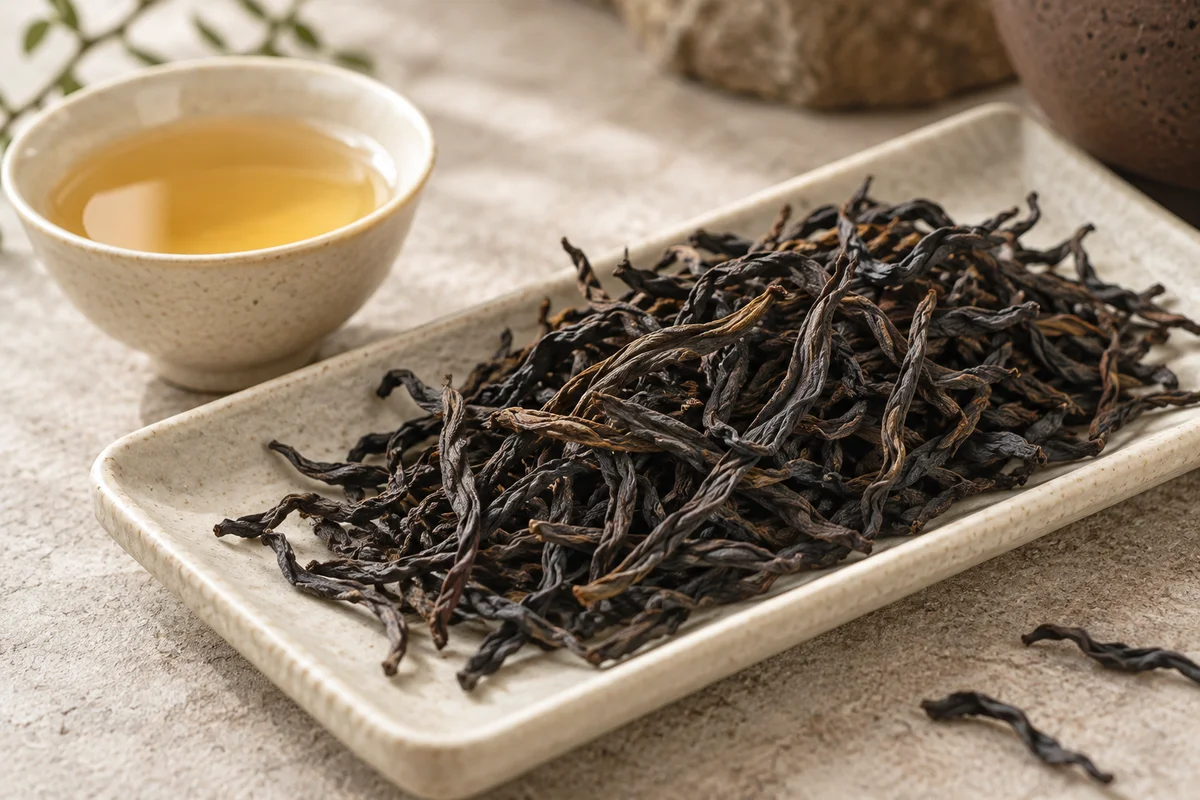
Dancong commonly appears as long twisted strips rather than tightly rolled pellets. The dry leaf can look dark even when the cup is relatively bright. Colour does not fully describe its aromatic range. Smelling the warm wet leaves can reveal floral or fruity impressions that were less apparent in the unopened packet. A small cup then lets you notice what remains after swallowing, rather than treating the first powerful aroma as the whole experience.
An evocative description should remain an invitation, not an instruction. If you know the smell of orchids only from a florist's shop, you need not invent a precise orchid note. A broad observation such as floral with a fruit-like finish can be both honest and useful.
Give intensity a little discipline
A strongly aromatic leaf can become difficult to read if it is prepared too aggressively for the chosen method. Start with the supplier's directions and remember that a small-pot, high-leaf method is not the same recipe as a large mug. Copying the leaf quantity from one and the steeping time from the other can create a cup that says more about the mismatch than about the tea.
Try one named style before buying several whose names promise different flowers. Once you know its balance of fragrance, body and drying finish, another sample becomes easier to compare. The purpose is not to collect every aroma name. It is to discover which kind of fragrant tea remains enjoyable through the whole cup, including the quieter moments after its first impressive scent.