Why a sweet often comes before matcha
A sweet served with matcha is part of the sequence and the sensory contrast, not merely decoration beside the bowl.
The sweet has a place in the sequence
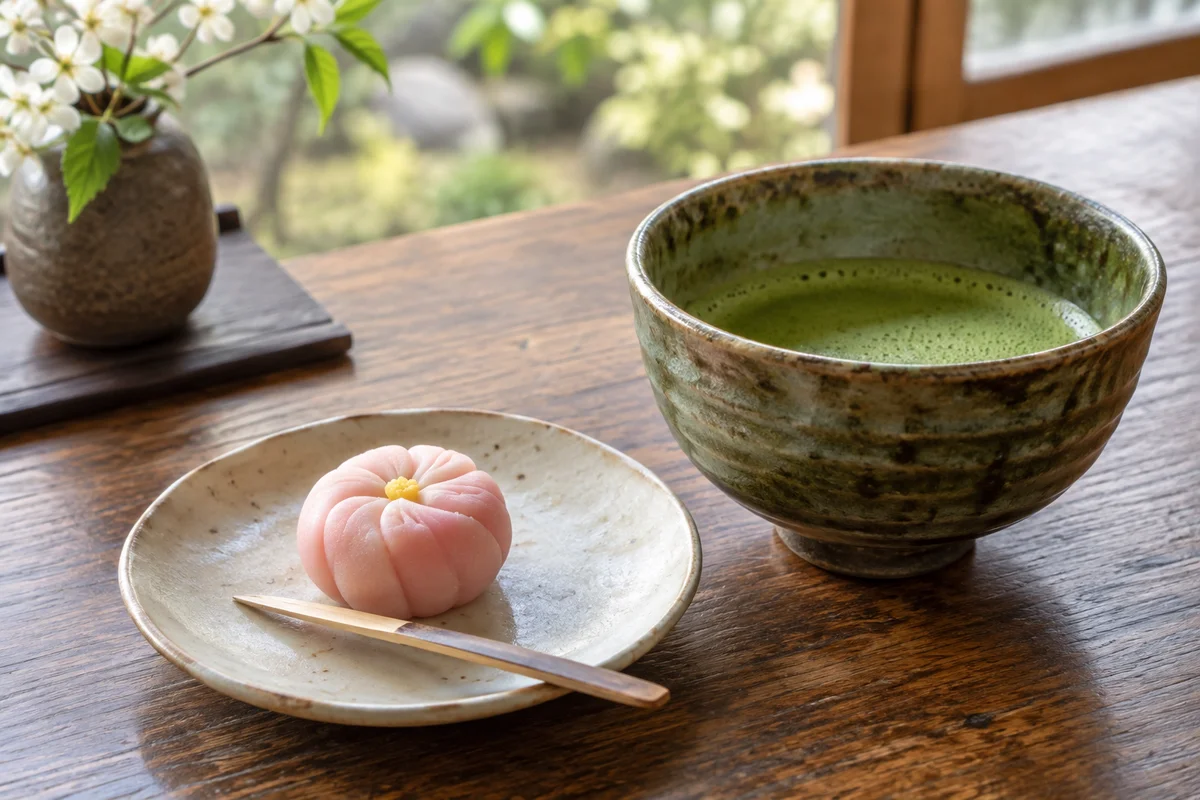
At many introductory Japanese tea experiences, a sweet accompanies matcha and may be eaten before the bowl is served. Follow the timing explained by your host rather than assuming the sweet must be saved as a dessert after the drink. That sequence changes how the tea arrives on the palate. Sweetness can make the next mouthful feel different, while the tea provides another texture and a less sugary finish. The contrast is something you can notice without turning it into a technical tasting exercise.
The sweet itself deserves a moment of attention. Its shape, colour, surface, and portion may have been chosen with care. Look before eating, but do not let a photograph delay the gathering indefinitely. If a small utensil is supplied, watch the demonstration or ask how it is intended to be used. There is no need to handle an unfamiliar delicate sweet awkwardly just to avoid asking a simple practical question.
Ingredients matter more than appearances
A flower-shaped piece does not tell you what is inside. If you need to avoid an ingredient, ask in advance and use the organiser's actual information. Bean paste, flour, starch, and other ingredients can appear in different forms, and visual resemblance is not a reliable guide. A venue may be able to describe a sweet without being able to guarantee a suitable replacement. Knowing this before booking is much easier than discovering it at the table.
When tasting, separate observations from assumptions. A smooth filling and a firm outer layer are things you can describe directly. A claim that every colour has the same meaning in every season or school would need much more context. If the host explains a particular name or seasonal reference, note it as part of this gathering. That specific detail is more interesting than attaching an elaborate symbolism that nobody present has actually mentioned.
Carry the contrast into an ordinary afternoon
At home, you can explore a modest sweet alongside tea without claiming to recreate a formal ceremony. Choose a small portion so that neither element overwhelms the other, and compare the tea before and after a bite. Your preference may change with the sweet. The useful lesson is attention to sequence and balance, not the idea that one confection is compulsory whenever matcha is served.