Oriental Beauty and its multicoloured leaves
The mixed colours of Oriental Beauty belong to a distinctive Taiwanese oolong. Honey-like aroma does not mean added honey.
A varied leaf rather than a green ball
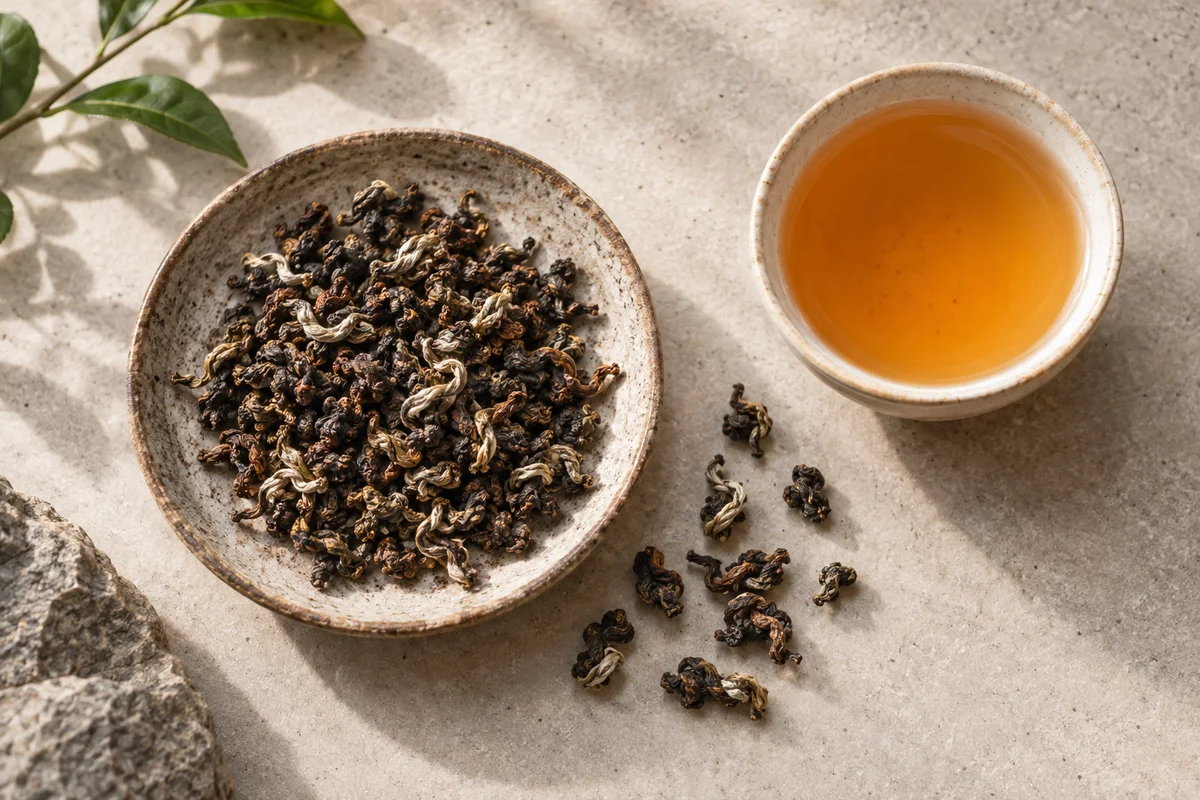
Oriental Beauty, also known as Dong Fang Mei Ren, is a Taiwanese oolong often recognised by a mixture of small twisted leaves and pale tips. Brown, reddish and silvery pieces can appear together. This is a different visual world from the evenly green rolled balls that many people first meet as Taiwanese oolong. The mixed colours are not a signal that unrelated teas have necessarily been blended together. They are part of the style's distinctive appearance and deserve to be seen before the first infusion.
A surprising influence in the field
The style is associated with tea leaves affected by small leafhoppers while growing. The plant's response, together with subsequent processing, contributes to the characteristic aromatic direction. This is not a matter of adding insects to the finished drink. The useful point for a reader is that events in the growing leaf can influence the eventual cup, just as shaping and drying do later. It also explains why simply copying the colour of the dry tea would not reproduce its character.
Honey as an aromatic comparison
Honey-like and ripe-fruit descriptions often appear around Oriental Beauty. They refer to sensory impressions rather than a necessary honey ingredient. A plain tea can smell sweet without tasting like a sweetened beverage. Check the label if you need to know what has been added, but do not turn a tasting note into an ingredient list.
The cup may feel closer to some fragrant black teas than to a very green oolong, yet it remains its own style. Let the tea cool enough to assess its aroma and texture comfortably. A dramatic first smell is only part of the experience; the finish can be quieter and just as revealing.
Buy a cup, not a legend
This tea attracts romantic stories and prestigious descriptions. A first sample does not need an elaborate backstory to be worthwhile. Look for a clear product description and prepare it as advised. Notice whether the fruit-like fragrance, body and drying edge sit well together. If you enjoy the result, try another lot later. Comparing real cups is a better way to learn the style than assuming that every expensive packet must deliver the same celebrated honey note.