Harvest date, packing date, best before
Harvest, packing, and best-before dates describe different stages. Read the words beside the number before drawing conclusions.
Three dates, three meanings
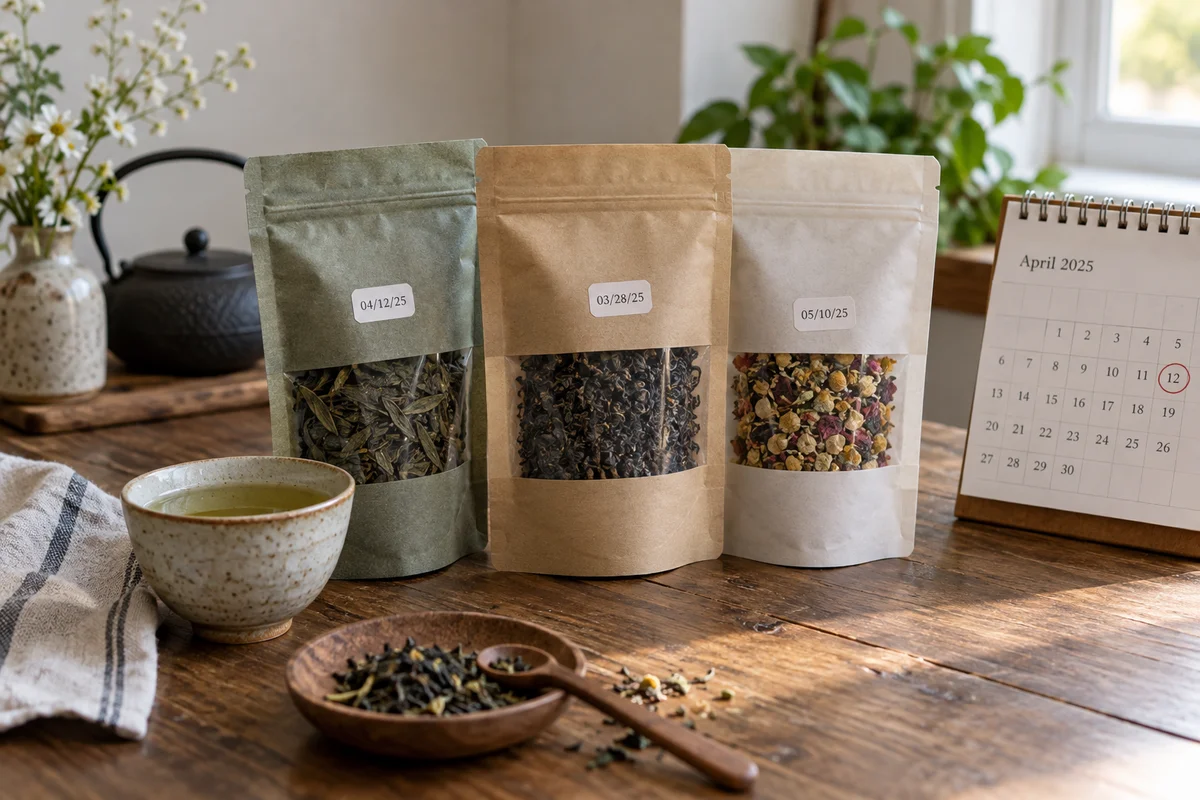
A date printed on a tea packet may refer to picking, packing, or the period for which the producer expects the unopened product to retain its stated qualities under suitable storage. Those are not interchangeable facts. A recent packing date does not prove a recent harvest. A harvest year does not tell you when the packet was opened or how it travelled. Start by identifying the date's label, not simply deciding that the newest number must be best.
For seasonal teas, harvest information can help you compare like with like. Record the year and, where supplied, the season or named picking period. Do not assume that a word such as spring has the same calendar dates in every growing region. Nor should you expect all teas to be marketed with equally detailed harvest records. A familiar blended everyday tea and a small seasonal lot may be sold with different kinds of information for sensible reasons.
Read storage instructions alongside the date
A best-before statement is about quality under the stated conditions, rather than an automatic instruction to discard the tea on the following morning. It also does not promise that an opened packet will taste unchanged until that date. Opening exposes the contents to the environment, and handling then matters. Follow the producer's instructions, especially for delicate products, rather than borrowing a freshness timetable from an unrelated tea.
If the date format is unclear, ask. A short numerical stamp can be ambiguous across markets, and an unfamiliar code may be a lot number rather than a date at all. Photograph the whole printed area when contacting the seller. The words around the numbers and the product name often resolve the question more quickly than a message containing only three digits and a guess. Keep the label if you transfer the tea to a storage tin.
Use dates to support a decision
For a first purchase, ask whether the listed harvest is the stock that will actually be sent. For a repeat purchase, note whether the year or batch changed before blaming your kettle for a different cup. Dates are useful context, but they cannot replace good storage, clear product information, and tasting. An impressive harvest story is less helpful than a packet whose identity and condition you can understand.